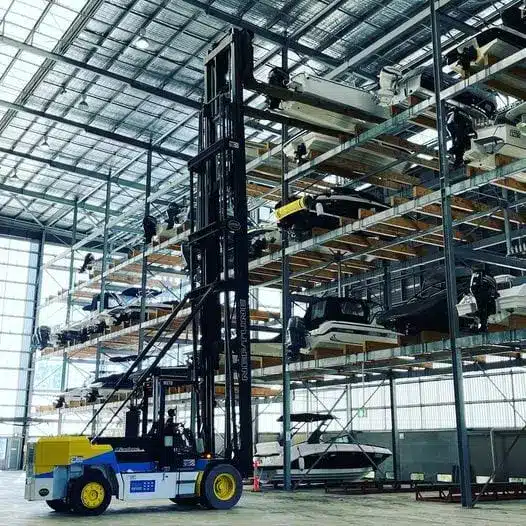
Dry-stack storage keeps a boat out of the water on a rack, with staff or machinery launching and retrieving it for use. It can reduce some in-water maintenance and remove the need to tow on every trip, but it also changes how spontaneously you can use, load and work on the boat.
This guide compares dry stack, marina berths, swing moorings and trailer storage for Sydney boat owners. There is no universally best option: suitability depends on vessel dimensions, operating area, access expectations, maintenance, budget and how often you go boating.
Boat storage options at a glance
| Storage type | Main advantage | Main limitation | Often suits |
|---|---|---|---|
| Dry stack | Boat is stored ashore and launch handling is provided | Operating hours, notice periods and vessel limits may apply | Compatible trailer-style powerboats used within facility hours |
| Marina berth | Direct walk-on access and ability to leave larger boats afloat | Ongoing berth and in-water maintenance costs | Frequent users and vessels that need immediate onboard access |
| Swing mooring | Can cost less than a full-service marina berth | Tender access, exposure, inspection and limited shore services | Owners comfortable with mooring access and a vessel suited to it |
| Trailer storage | Control over location and access, plus flexibility to visit other waterways | Towing, ramp queues, launch skill, space and trailer maintenance | Trailerable boats and owners with a suitable vehicle and storage area |
Availability, terms and facilities vary widely across Sydney. Compare the written agreement and actual operating process, not only the advertised weekly or monthly price.
How dry-stack boat storage works
The boat is normally stored on a purpose-built rack inside or outside a facility. When the owner books a launch, staff use a forklift, travel lift or other equipment to place it in the water. After use, the boat is retrieved and returned to the rack.
Some facilities include a washdown, flushing area, fuel access, work berth or loading zone. Others provide storage and lifting only. The owner may need to book ahead, arrive within a collection window and return before a closing time.
Ask to observe the launch, loading and retrieval process for a boat similar to yours. This reveals far more about weekend queues, access and staff handling than a brochure.
Advantages of dry-stack storage
The hull and underwater gear remain out of the water
Removing the boat after each trip can reduce continuous exposure to marine growth, electrolysis, corrosion, waterline staining and weather compared with leaving it afloat. It does not remove maintenance: engines still need flushing where specified, anodes and drives require inspection, and salt can remain on the hull and fittings.
No towing and ramp launch on every trip
Owners can avoid repeated towing, parking and ramp launching if the facility places the boat in the water. This can be valuable around busy Sydney ramps, especially for people without space at home.
Potentially less exterior exposure
Indoor or well-sheltered storage can reduce sun, rain, bird and airborne-debris exposure. Outdoor racks may provide less protection, and parts of the boat can still be exposed depending on the building and rack position.
Staff handling may simplify arrival and return
A reliable facility can make regular use more predictable by handling the lift. Some also provide staging areas for loading passengers or equipment. Confirm whether staff only launch the boat or also assist with lines, covers, flushing and fuel.
Disadvantages and trade-offs
Access is controlled by the facility
You may need to book a launch, wait during peak periods and return before staff finish. Very early departures, late evenings and last-minute weather windows may be harder than with a berth or trailer under your control.
Not every vessel fits
Facilities set limits for length, beam, height, weight, hull form, propulsion and rack support. A hardtop, aerial, tower, outboard position or aftermarket equipment can affect clearance. Provide accurate loaded dimensions and weight in writing.
On-rack access may be restricted
Owners may not be allowed onto a boat while it is in the rack or perform maintenance inside the storage building. Loading gear, charging batteries, cleaning covers and completing repairs may require a booked work area or launch.
Handling risk and responsibility need clarification
Ask who is responsible for damage during lifting, rack storage, storms, launching, retrieval and staff movement. Check whether the facility requires lifting points, provides rack support for the hull and records existing damage.
The advertised price may not be the total cost
Possible additional charges include launches above an allowance, after-hours access, washdown, flushing, forklift movements for maintenance, fuel, trailer storage, work berths, electricity and cancellation fees.
Does dry stack mean no antifouling?
A boat stored out of the water for almost all of its life may not need the same antifouling schedule as one continuously afloat. However, the answer depends on:
- how long the boat remains in the water on each trip;
- whether it sometimes stays afloat overnight or for extended periods;
- the hull and drive manufacturer’s requirements;
- existing coatings and warranty conditions;
- the local marine-growth environment; and
- advice from an appropriate marine coatings professional.
Do not remove or skip a coating solely because a storage salesperson says antifouling is unnecessary. Confirm the correct preparation and coating system for the actual boat.
Will dry-stack storage reduce insurance?
It may influence risk and premium, but there is no universal discount. Insurers consider the vessel, value, storage location, security, storm exposure, operator, claims history and cruising area, among other factors.
Tell the insurer the exact facility and storage arrangement. Ask about:
- cover while the boat is on the rack;
- cover while facility staff lift or move it;
- storm, flood, fire, theft and malicious damage;
- operator and security requirements;
- existing-damage documentation; and
- whether accessories, tender and trailer are included.
Read both the facility agreement and insurance policy. Do not assume one party automatically pays for every type of handling or storage damage.
Dry stack versus a marina berth
A marina berth normally gives direct access for loading, maintenance and spontaneous departures. It can better suit larger cruisers, liveaboard-style preparation, shore power and owners who boat outside staffed hours.
In return, an in-water vessel needs regular attention to antifouling, anodes, seacocks, bilge systems, lines, fenders, corrosion and weather exposure. Berth fees and service availability vary significantly.
Choose based on use. A small powerboat used for daytime trips may gain more from dry-stack handling; a cruiser used for dawn departures and overnight stays may gain more from walk-on access.
Dry stack versus a swing mooring
A swing mooring can be economical but usually requires tender or contractor access. The boat remains exposed to weather and afloat between trips, and the owner must monitor the vessel, mooring lines, chafe, bilge and systems.
A dry stack removes the boat from the water and avoids tender transfers, but facility access is less independent. A mooring licence or apparatus is also not automatically transferred with a boat purchase; confirm all current NSW and operator requirements separately.
Dry stack versus trailer storage
Trailer storage provides the greatest ability to move between Sydney Harbour, Pittwater, Botany Bay and other waterways, subject to legal towing, road and ramp requirements. It also puts launch timing under the owner’s control.
The trade-off is the tow vehicle, home or yard space, trailer maintenance, ramp conditions, queueing and the skill needed to launch and retrieve safely. Dry stack removes most towing and ramp work but ties the boat to one launch location and operating system.
Questions to ask a Sydney dry-stack facility
Access and launching
- What are the launch and retrieval hours on weekdays, weekends and public holidays?
- How much notice is required?
- How are peak summer and holiday queues managed?
- What happens if I return after closing or weather delays the trip?
- Is there a safe work berth or staging area for passengers and gear?
- Can somebody other than the named owner request or operate the boat?
Vessel fit and handling
- What are the maximum loaded length, beam, height and weight?
- Are my hull form, steps, strakes and propulsion compatible with the rack?
- Must aerials, covers or a wake tower be lowered?
- How are support positions recorded and kept away from vulnerable areas?
- Who operates the lift and what training or procedures apply?
- How is damage documented at entry, launch and retrieval?
Services and maintenance
- Is freshwater engine flushing included, available or the owner’s responsibility?
- Is hull washdown included, and what parts are washed?
- Can batteries remain on a maintainer?
- Can the owner or a contractor work on the boat?
- Are fuel, pump-out, waste, detailing and mechanical services available?
- Can the boat stay in the water overnight or be moved to a work berth?
Agreement, security and cost
- What is included in the quoted price?
- Are launches, washdowns, after-hours returns or work movements charged separately?
- What notice period and price-review terms apply?
- What insurance must the owner maintain?
- What liability does the facility accept while handling the vessel?
- How are fire, storm, flood, theft, power failure and evacuation risks managed?
Inspect the facility in person
Visit during a realistically busy period. Look at:
- traffic flow for cars, trailers, forklifts and pedestrians;
- passenger boarding and child-safety arrangements;
- the condition and spacing of racks;
- fire protection, security and access control;
- how staff communicate with skippers during launch and retrieval;
- washdown drainage and environmental controls;
- the marina approach, wind exposure and nearby traffic; and
- parking, loading and storage for covers and equipment.
Ask existing customers about ordinary weekends, not only quiet midweek service.
Prepare a boat for rack storage
Follow the manufacturer’s and facility’s procedures. A return checklist may include:
- accounting for all lines before entering the retrieval area;
- removing rubbish, perishables and wet equipment;
- flushing engines and washing salt as specified;
- checking bilges, pumps, leaks and fuel smells;
- isolating batteries or connecting approved charging equipment;
- closing fuel, gas, water and seacock systems as appropriate;
- lowering aerials and securing loose equipment;
- ventilating the boat without allowing rain entry;
- fitting an approved cover that will not chafe; and
- reporting defects before the next launch.
Do not assume a boat stored ashore cannot take on water. Covers can pool rain, plumbing can leak and bilge arrangements may behave differently when the hull is angled on a rack.
Who is dry-stack storage best for?
It can be a good match when:
- the boat fits the facility’s rack and lifting limits;
- most trips occur during reliable operating hours;
- the launch location suits your normal cruising area;
- you want to avoid towing and repeated ramp launching;
- you value reduced time afloat; and
- the complete cost and access terms are acceptable.
It may be a poor match if you need unrestricted access, regularly depart before dawn or return late, do frequent onboard maintenance, carry large amounts of gear, own an incompatible vessel or want to explore many distant waterways by trailer.
Frequently asked questions
Is dry-stack storage cheaper than a marina berth?
Sometimes, but prices depend on vessel dimensions, location, access and included services. Compare the total annual cost, including launch fees, work movements, washdown and the maintenance differences for your boat.
Can I access my boat whenever I want?
Not necessarily. Most facilities have operating hours, booking requirements and safety restrictions for rack access. Confirm early departures, late returns and peak-period procedures in writing.
Can any boat go into dry stack?
No. Length, beam, height, loaded weight, hull form and propulsion must fit the facility’s lift and rack system. Modifications such as towers, aerials or extended platforms also matter.
Do dry-stacked boats still need maintenance?
Yes. Engines, drives, anodes, batteries, steering, fuel, bilge, safety equipment, covers and the hull still require inspection and servicing. Out-of-water storage changes some maintenance—it does not remove it.
What if I buy a boat already stored in a dry stack?
Do not assume the storage agreement transfers. Confirm the facility will accept you and the vessel, obtain new terms, arrange insurance and document condition before staff next move the boat.
Choose storage around how you actually boat
Storage affects every departure and return. Use the BoatWise NSW new boat owner guide to include storage, insurance, systems and maintenance in your first-90-days plan.
If you want practical help launching, docking or handling a newly purchased boat, BoatWise Private Boat Tuition is tailored to your vessel, marina or agreed Sydney location.
About the author
Tristian Mooney is the founder, captain and head trainer of BoatWise. He has spent 12 years working in the maritime industry across practical boat handling, vessel operations, training and luxury-vessel management. He has worked across thousands of makes and models, from trailer boats to large luxury cruisers. Learn more about Tristian and BoatWise.
Last reviewed: 11 August 2026. Storage facilities, availability, prices and terms change. Inspect the facility and confirm the current written agreement, insurance and vessel requirements.