Reviewed and updated by Tristian Mooney on 21 August 2026.
Safe anchoring is more than lowering an anchor until it touches the bottom. The skipper must choose a suitable location, understand the seabed and forecast, allow enough rode and swing room, set the anchor properly and keep checking that it is holding.
This practical guide explains how to anchor a recreational boat safely in New South Wales, with extra attention to the wind, tide, confined anchorages and busy traffic Sydney boaters regularly experience.
Quick answer: how do you anchor a boat safely?
- Choose a legal, sheltered anchorage with suitable depth, seabed and swing room.
- Check the wind, tide, current and conditions expected throughout your stay.
- Prepare the correct anchor and rode, which is the chain and/or rope connecting the anchor to the boat.
- Approach the drop point slowly into the dominant wind or current where practical.
- Stop the boat and lower the anchor under control. Do not throw it.
- Let the boat move astern while paying out the planned amount of rode.
- Secure the rode correctly and apply controlled reverse power to set the anchor.
- Confirm the hold using fixed visual transits, position information and an anchor alarm where appropriate.
- Continue monitoring the boat, weather, tide and nearby vessels.
- When leaving, start the engine first and retrieve the anchor with clear crew communication and the rode kept away from the propeller.
Choose the anchorage before preparing the anchor
A safe anchorage should provide protection from the wind, waves and current expected during the entire stay, not only the conditions when you arrive. A bay that is comfortable in one wind direction may become exposed after a forecast change.
Before committing, check:
- Legality: current charts, maps, signs and local restrictions.
- Under-keel clearance: the minimum depth expected when the tide is at its lowest during your stay.
- Maximum water depth: the greatest bow-roller-to-seabed distance expected, which you will use to calculate scope.
- Seabed: whether your anchor is suitable for sand, mud, rock or mixed ground.
- Protection: wind direction, wave and swell exposure, wash and current.
- Swing room: enough space for your boat and surrounding vessels to swing without contact.
- Hazards: channels, cables, reefs, shallow water, moorings, swimmers and shore structures.
- Exit: a safe route out if the anchor drags or conditions deteriorate.
Under current Transport for NSW anchoring guidance, you must not anchor in a navigation channel, where you may obstruct access to wharves, launching ramps or moorings, or within 200 metres of an underwater cable. Avoid sensitive habitats such as shallow seagrass areas and check for locations where anchoring is prohibited even if no sign is visible.
A confined or crowded bay does not make short scope safe. If you cannot deploy sufficient rode and still maintain a safe swing circle, choose another anchorage or use a suitable mooring or berth.
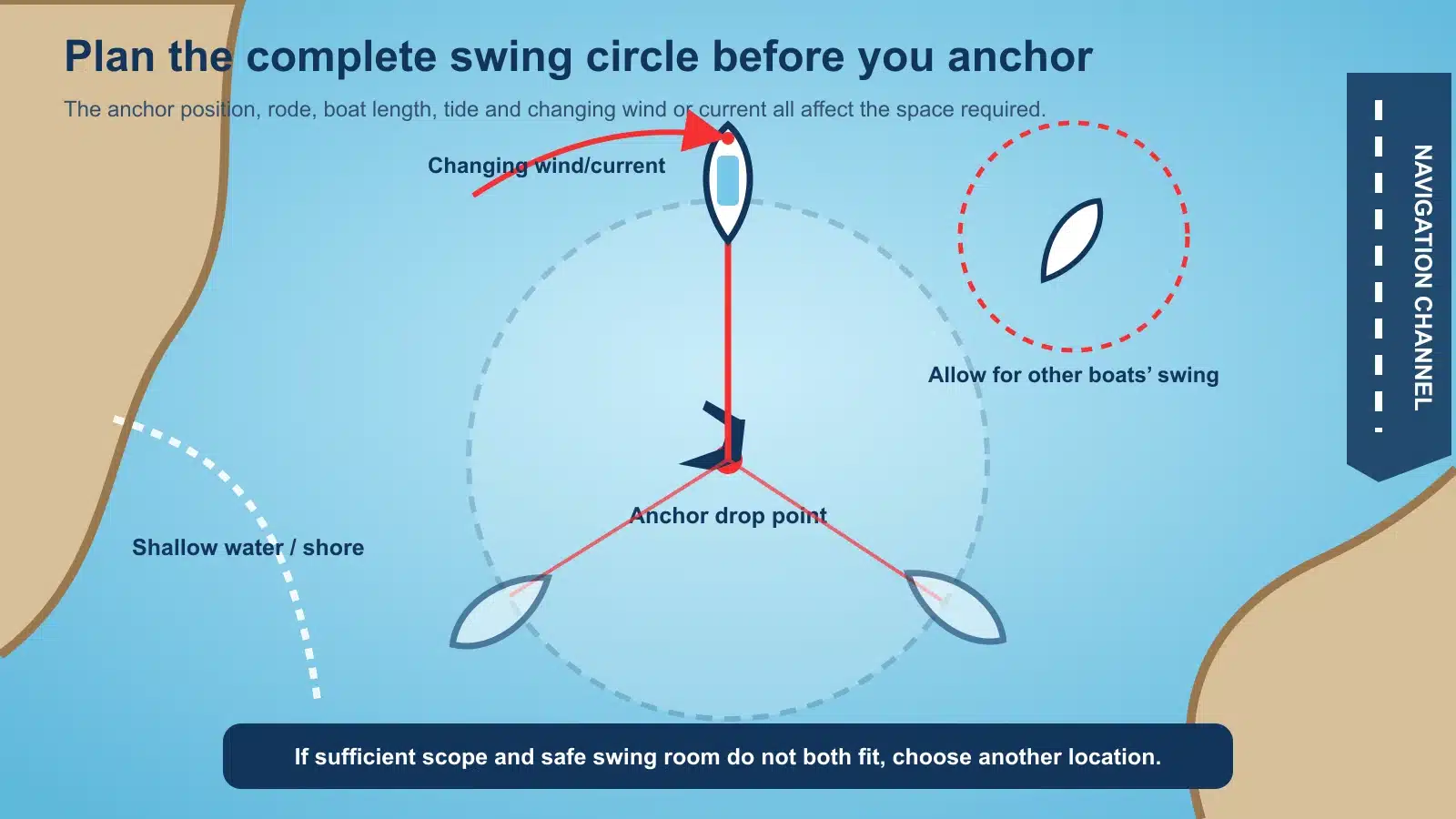
Plan the drop point and the full swing circle before lowering the anchor.
Match the anchor to the boat and seabed
There is no single anchor that is best for every vessel and seabed. Holding depends on the anchor design and size, vessel weight and windage, rode, seabed and how correctly the anchor is set.
| Anchor type | Common application | Important limitation |
|---|---|---|
| Danforth or fluke | Often effective in sand and mud. | Can struggle to penetrate weed, very hard ground or rock. |
| Plough, spade or similar burying anchor | Common general-purpose choice for sand and mud; many designs reset well after a direction change. | Performance varies by design and seabed. It may foul on rock or reef. |
| Claw or Bruce-style anchor | Often used as a general-purpose anchor in sand or mud. | Holding power and setting performance depend heavily on size, design and bottom conditions. |
| Reef or grapnel anchor | A specialised additional anchor for rocky or reef areas. | Not a general-purpose substitute for the vessel’s main anchor. Avoid environmentally sensitive reef areas and follow local restrictions. |
Use the vessel or anchor manufacturer’s sizing guidance and seek qualified advice if the boat’s setup has changed. Transport for NSW also provides guidance on anchors and essential safety equipment.
Before departure, check that:
- the anchor is the correct type and size for the vessel and expected seabed;
- chain, rope, shackles, swivels, thimbles and attachment points are correctly rated and in good condition;
- shackle pins are secured appropriately;
- rope is free from serious chafe, cuts, stiffness or UV damage;
- chain or rode markings allow the crew to estimate how much has been deployed;
- the bitter end is securely attached in accordance with the vessel’s safe emergency arrangement; and
- the windlass, bow roller, cleats and manual recovery method are understood before use.
A windlass is primarily a deployment and retrieval aid. Do not assume it is designed to take the vessel’s full anchoring load. Follow the vessel and windlass manufacturers’ instructions and use the designated securing arrangement.
Understand anchor scope
Scope is the ratio between the length of rode deployed and the vertical distance from the boat’s bow roller to the seabed. A flatter pull generally helps a burying anchor remain set. A short, steep rode is more likely to lift the anchor out.
Transport for NSW advises allowing at least three times the depth in normal conditions and increasing to 5:1 or more when the weather deteriorates or the current is strong. BoatWise uses a more conservative practical starting point:
| Scope | BoatWise guidance |
|---|---|
| 3:1 | An absolute minimum, not the everyday target. Consider only for a short, closely monitored stop in very settled conditions, good holding ground and with a correctly sized and well-set anchor. |
| 4:1 | A practical BoatWise starting point for settled, sheltered conditions with suitable holding ground and adequate swing room. |
| 5:1 or more | Use as wind, current, waves, poor holding ground, vessel windage or the length of stay increases. It is a sensible starting point for many overnight situations. |
| 6:1 to 7:1 | May be appropriate in increasingly demanding conditions, provided the anchorage offers enough room. |
| 8:1 to 10:1 | May be considered in severe or storm conditions only when the anchorage, anchor, seabed, rode, deck fittings and swing room can safely accommodate it. |
These ratios are starting points, not guarantees. Rode type, forecast, tide range, waves, seabed, anchor design, vessel windage, chafe and equipment limits all matter. Do not attach a single wind-speed limit to every boat and anchoring system.
Severe-weather warning: more scope alone does not create a safe storm anchorage. If severe weather is forecast, the safer plan may be to leave early for a properly sheltered berth or suitable mooring. Storm anchoring requires an appropriate anchor and rode, adequate swing room, chafe protection, correctly rated fittings, continuous monitoring and a clear emergency plan.
Scope example
If the water will be 4 metres deep at its highest during your stay and the bow roller is 1 metre above the water, the vertical distance to the seabed is approximately 5 metres:
- 3:1 scope = approximately 15 metres of rode;
- 4:1 scope = approximately 20 metres;
- 5:1 scope = approximately 25 metres; and
- 7:1 scope = approximately 35 metres.
Separately, confirm that the vessel will retain safe under-keel clearance at the lowest water expected. Then make sure the anchorage provides sufficient swing room for the rode deployed, the vessel’s length and possible changes in wind or current.
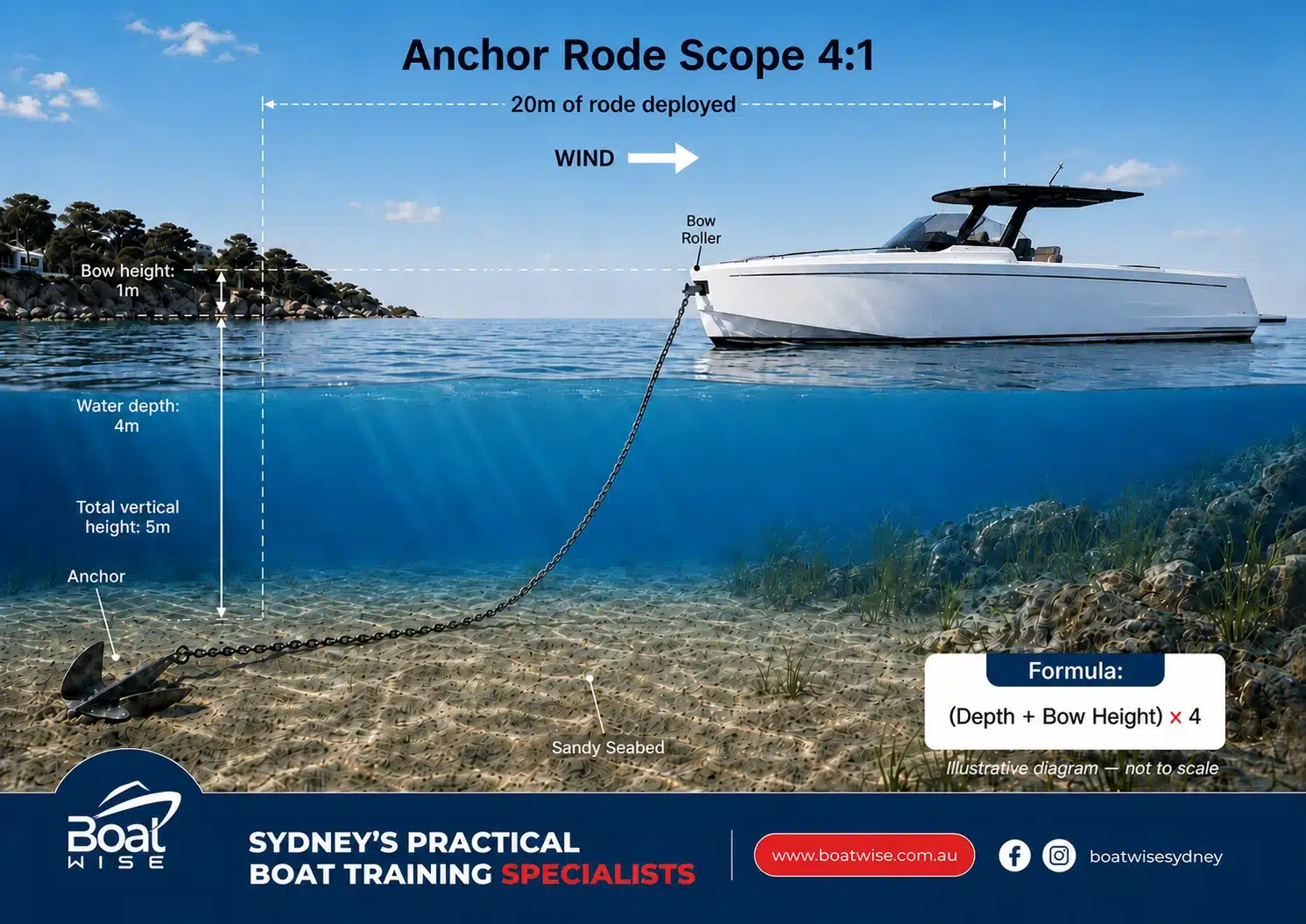
BoatWise 4:1 scope example. Calculate scope from the bow roller to the seabed, not from water depth alone. The 20 metres shown is the length of rode deployed; the illustration is not to scale.
Prepare before entering the anchorage
Preparation prevents a rushed foredeck operation. Before the final approach:
- brief the crew and nominate one person to control the anchor;
- agree on clear hand signals or short commands;
- remove covers, pins or securing devices while in a safe area;
- check that the rode can run without tangles;
- confirm the bitter end is secured appropriately;
- keep feet, hands and loose clothing away from the rode and windlass;
- keep children and unbriefed passengers away from the anchoring area; and
- identify the planned drop point and final resting area after the boat moves astern.
A rode under load can move suddenly and cause serious injury. Nobody should stand on the rode or inside a loop of rope.
Step by step: setting the anchor
1. Read the dominant force
Observe how nearby anchored boats are lying and compare the wind with the current. Boats with different hull shapes and windage may lie differently, especially when wind opposes tide, so use several clues rather than copying one vessel.
2. Approach the drop point slowly
Approach into the dominant wind or current where practical. Keep wash low and allow enough space ahead of the intended final position for the boat to travel astern while the rode is paid out.
3. Stop the boat over the drop point
Use neutral and controlled gear inputs to remove forward movement. Confirm the depth, traffic and planned escape route one final time.
4. Lower the anchor under control
Lower the anchor until it reaches the seabed. Do not throw it or pile the chain on top of it. The crew should report when the anchor reaches the bottom.
5. Move astern while paying out rode
Allow the wind or current, or use gentle reverse gear, to move the boat astern. Pay out the rode progressively so it lays along the seabed rather than tangling.
6. Deploy the planned scope
Use chain markers or another reliable method to measure the rode. Include bow height and the greatest expected water depth in the calculation.
7. Set the anchor
Secure the rode using the vessel’s correct anchoring arrangement and apply controlled reverse power appropriate to the vessel, anchor and equipment. The load should increase steadily. Snatching, skipping or continued movement over the ground may indicate that the anchor has not set.
8. Confirm the hold
Use two fixed visual transits ashore, position information on the chartplotter and an anchor alarm where appropriate. Wait several minutes and confirm that the boat is swinging around a stable position rather than continuing to move away.
How to tell if the anchor is dragging
Possible warning signs include:
- fixed landmarks no longer lining up;
- distance from the selected position increasing continuously;
- the anchor alarm activating outside a sensible swing circle;
- the rode vibrating, jumping or failing to load steadily; and
- the boat moving differently from nearby anchored vessels in similar conditions.
GPS movement alone can be misleading while the boat swings, and one visual reference can be misleading because of perspective. Use more than one method.
If the anchor is dragging, act early. Start the engine, alert the crew, keep clear of hazards and either reset in a better position with appropriate scope or leave the anchorage. Do not wait until the boat is close to another vessel, shore or shallow water.
Monitor the boat after anchoring
The skipper remains responsible after the anchor is set. Continue checking:
- forecast updates and marine warnings;
- the boat’s position and swing circle;
- tide height and current;
- distance to nearby vessels and hazards;
- the rode, bow fitting, securing arrangement and chafe points; and
- whether the planned exit remains clear.
Anchor lights in NSW
At night (from sunset to sunrise) and during restricted visibility, vessels at anchor up to 50 metres long must display an all-round white light where it can best be seen. If the vessel uses sidelights while underway, switch them off while at anchor. In a busy location, keep a proper lookout and consider additional deck or cabin lighting that does not obscure the required anchor light. See the current NSW navigation-light requirements.
Overnight anchoring calls for a more conservative plan, appropriate lighting, active watchkeeping and a clear response if wind, tide or traffic changes. If you do not have the experience or equipment for the forecast conditions, use a suitable berth or mooring instead.
Step by step: retrieving the anchor safely
- Start the engine and allow it to reach a reliable idle before releasing the boat from the anchor.
- Check surrounding boats, traffic, shallow water and the planned escape route.
- Brief the crew and confirm the windlass controls and hand signals.
- Motor slowly towards the anchor while the crew retrieves only the slack rode. Do not use the windlass to drag the boat against heavy wind or current unless the manufacturer specifically permits that load.
- Use neutral whenever crew are handling rode near the bow or when there is any chance of rope or chain passing beneath the hull. Keep the skipper informed of the rode’s direction at all times.
- When directly above the anchor and with the rode clear of the propeller, use controlled vessel movement and the correct retrieval system to break the anchor free.
- Once the anchor is clear of the water, secure it fully before accelerating or entering traffic.
What if the anchor is stuck or fouled?
Avoid heavy, uncontrolled pulling. Reassess the direction of load, surrounding hazards and the limits of the boat, windlass, cleats and rode. Approaching carefully from a different direction may help, but the rode must remain clear of the hull and propeller.
If an anchor is caught on an underwater cable, NSW guidance says not to pull it out. Cut the anchor line as close as safely possible to the anchor. Protecting people and the vessel takes priority over recovering equipment.
Common anchoring mistakes
- Choosing the position before checking the forecast, tide or possible wind change.
- Calculating scope using water depth alone and forgetting the bow height.
- Using 3:1 as a routine target rather than an absolute minimum.
- Shortening the rode merely because the anchorage is crowded.
- Failing to allow for the complete swing circle.
- Dropping beside another vessel without allowing for different swing behaviour.
- Anchoring by the stern, which can expose the stern to waves and increase the risk of swamping.
- Throwing the anchor and chain into a pile.
- Assuming the anchor is set without testing and monitoring it.
- Standing on or inside loops of rope.
- Using the windlass to pull the full weight of the boat forward.
- Allowing retrieved rope to pass near the propeller.
- Anchoring in seagrass, a channel, a cable area or another restricted location.
- Assuming that additional scope alone makes severe-weather anchoring safe.
Frequently asked questions
How much anchor rope or chain should I let out?
BoatWise recommends approximately 4:1 as a practical starting point in settled, sheltered conditions with good holding ground. Treat 3:1 as an absolute minimum for a short, closely monitored stop. Increase to 5:1 or more as wind, current, waves, overnight exposure or uncertainty increases. Always calculate using the vertical distance from the bow roller to the seabed.
Should I anchor from the bow or stern?
Anchor from the bow. Anchoring by the stern can expose the transom to waves and increase the risk of water entering or swamping the boat.
Is 3:1 scope enough in a tight bay?
Do not shorten the rode simply to fit into a tight or crowded anchorage. Three-to-one is an absolute minimum, not the preferred everyday target. If you cannot maintain both sufficient scope and a safe swing circle, choose another anchorage, mooring or berth.
How do I know whether the anchor has set?
Apply a controlled load, observe the rode and confirm the boat’s position using at least two fixed visual transits and electronic position information. Keep monitoring after the initial set.
Can I anchor anywhere on Sydney Harbour?
No. Navigation channels, access routes, underwater-cable areas, sensitive habitats and locally restricted areas must be avoided. Check current charts, maps, signs and NSW guidance before anchoring.
Do I need an anchor light?
Yes, when anchoring at night or during restricted visibility. In NSW, vessels up to 50 metres long at anchor must display an all-round white light where it can best be seen.
Is an electronic anchor alarm enough?
No. It is a useful backup, but the alarm radius must allow for normal swing and GPS variation. Combine it with visual transits, chart awareness and regular checks.
Can a GPS anchor replace my physical anchor?
No. Transport for NSW states that GPS anchoring functions such as Spot-Lock are not considered anchors under NSW marine legislation and cannot replace a physical anchor required as safety equipment. See the NSW GPS-anchor guidance.
Is 10:1 scope enough for a storm?
There is no universal storm ratio. Eight-to-one or 10:1 may be appropriate in some severe conditions, but only if there is adequate room and every part of the anchoring system can manage the load. If severe weather is forecast, leaving early for a properly sheltered berth or suitable mooring may be safer than remaining at anchor.
Practise anchoring on your own boat
The correct technique depends on your boat’s anchor, rode, windlass, bow layout and operating area. BoatWise Private Boat Tuition can cover anchorage selection, scope, setting and retrieval, crew communication, wind and current and safe use of your own equipment.
Before planning the trip, read our guide to marine weather for Sydney boaters. If you prefer to stop at a marina or visitor mooring, see the current Sydney Harbour destination berths and moorings guide.
About the author
Tristian Mooney is the founder, captain and head trainer of BoatWise. He has spent more than 12 years working in the maritime industry across practical boat handling, vessel operations, training and luxury-vessel management. BoatWise tuition can include anchoring, swing moorings, docking, navigation, weather and onboard systems on clients’ own boats. Learn more about Tristian and BoatWise.
Last reviewed: 21 August 2026. Always check current NSW rules, charts, local restrictions, weather and the manufacturer’s instructions for your vessel and anchoring equipment.