Good boat handling is not a collection of tricks. It is the ability to understand the forces acting on the vessel, choose a low-risk plan and make small control inputs early enough for the boat to respond.
This guide gives new powerboat owners a practical framework for building those skills on Sydney waterways. It covers the foundations that sit underneath docking, anchoring, mooring and safe day-to-day skippering without pretending that every hull or propulsion system behaves the same.
The essential boat-handling skills at a glance
- Maintain a proper lookout and plan before moving.
- Control speed and momentum at low speed.
- Understand the vessel’s pivot point and stern swing.
- Use ahead, astern and neutral deliberately.
- Learn how your propulsion system behaves.
- Recognise wind, current, tide and wash.
- Prepare lines, fenders and crew before close quarters.
- Practise stopping, resetting and emergency responses.
1. Look, plan and leave yourself an escape
The first boat-handling decision happens before the throttle moves. Check the available space, depth, traffic, weather, wind, current, tide, wash, visibility and fixed hazards. Identify where the boat can move safely if the first plan stops working.
In Sydney Harbour, skippers share the water with ferries, commercial vessels, sailing boats, paddlers and swimmers. Channels, exclusion zones, speed limits and special operating areas can change the available space. Read the current NSW rules for boating on Sydney Harbour and use current charts and signs.
An escape plan should be specific: “If the bow passes this pile before we are aligned, I will select neutral, move clear into that open water and start again.” A vague plan to “fix it” near the berth is not enough.
2. Control momentum, not only engine speed
A boat in neutral can continue moving. The heavier the vessel and the faster it was travelling, the more time and distance it may need to slow. Wind and current can also keep changing the movement after propulsion is removed.
In suitable open water, learn:
- the speed produced by idle ahead and idle astern;
- how far the vessel coasts after neutral is selected;
- how long it takes to stop from different low speeds;
- the delay between a control input and the boat’s response; and
- how passenger load, fuel and water affect that response.
At close quarters, short gear inputs followed by neutral can control momentum without constantly adding speed. Avoid rapid, unplanned movement between ahead and astern; allow the propulsion system to engage as its manufacturer specifies.
3. Understand the pivot point and stern swing
A boat does not turn like a car. When the bow turns one way, the stern swings the other. The apparent pivot point also changes depending on whether the vessel is moving ahead, astern or rotating under differential thrust.
This matters when leaving a berth, turning in a marina or passing close to a pile. Watching only the bow can place the swim platform, outboard, stern quarter or tender into a hazard.
Practise slow turns around a safe visual reference in open water. Have a crew member observe the stern without obstructing the skipper’s view, then swap observations. Learn the full footprint of the boat.
4. Treat neutral as an active control
Neutral gives you time to observe. A useful low-speed sequence is:
- make one small steering or gear input;
- return to neutral;
- watch the bow, stern and movement over the ground;
- decide whether the input achieved the result; and
- make the next small correction.
This deliberate rhythm is usually more controllable than staying in gear and stacking several corrections before the boat has responded.
5. Learn how your propulsion system behaves
Single outboard or sterndrive
The propeller and thrust direction move with the steering. Steering response can differ ahead and astern, and an outboard may need water flowing past the gearcase before it responds as expected. Learn how quickly the drive turns and how much thrust idle produces.
Single shaft drive
A rudder normally has stronger authority when propeller wash flows across it in ahead. Astern steering may be weaker, while prop walk can move the stern to one side. Prop walk is useful when it supports the plan and a complication when it does not.
Twin engines
Differential thrust can rotate or move a twin-engine boat with limited steering input. Practise one lever at a time at idle in open water, noting the pivot, delay and momentum. Do not assume every twin-engine boat will spin in its own length or ignore wind.
Joystick systems
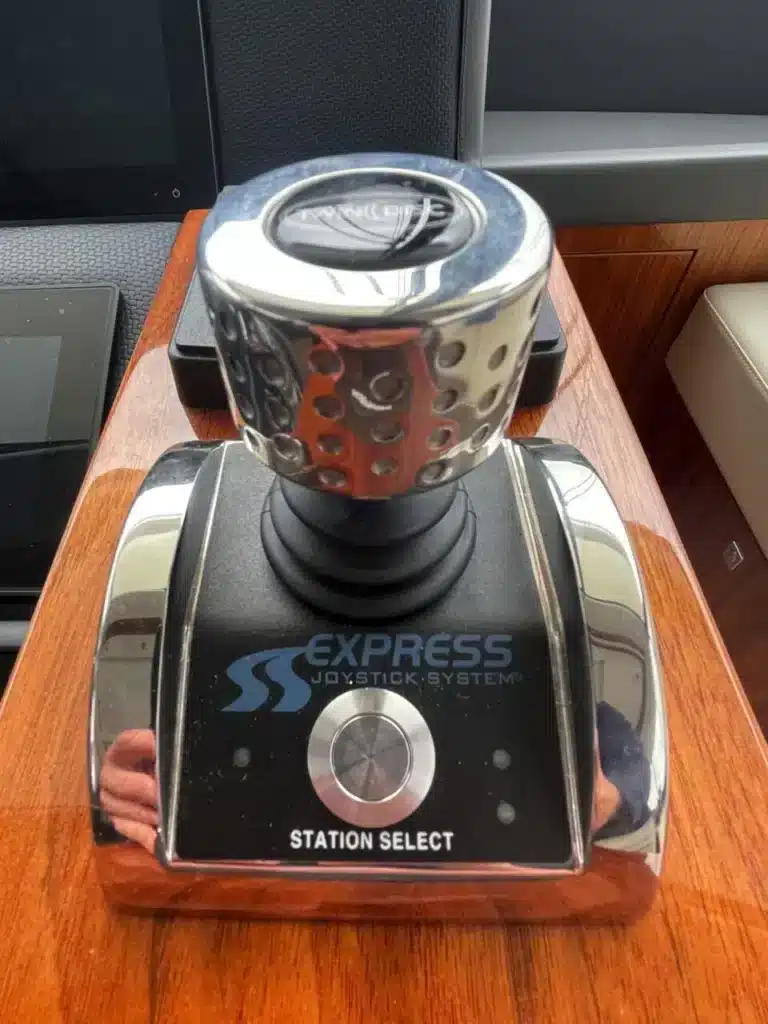
Joystick systems can coordinate engines, steering and thrusters, but their response varies with vessel setup and conditions. Learn the system’s modes, limitations and alarms, and remain able to use the primary controls if the joystick is unavailable.
Bow and stern thrusters
Thrusters provide short lateral corrections. They can lose effectiveness against strong wind, when water flow moves through the tunnel or when electrical or hydraulic limits are reached. Use them early and briefly; do not wait until the bow has gathered significant sideways momentum.
6. Separate speed through the water from movement over the ground
The engine controls the boat’s movement through the surrounding water. Current moves that water—and the boat within it—over the ground. A vessel can have enough water flow for steering yet still travel sideways or backwards relative to the marina.
Compare the boat against fixed references such as piles, pontoons and shoreline features. Do not rely only on the wake or water beside the hull. This distinction becomes critical in tidal entrances, around marina fairways and when approaching a mooring.
7. Identify the dominant force
At any moment, the boat may be influenced mainly by:
- propeller or jet thrust;
- existing momentum;
- wind on the hull, cabin, clears and covers;
- current or tidal flow;
- waves, ferry wash or another vessel’s propeller wash; or
- a line attached to a cleat.
Ask which force is strongest, where it is acting and what will happen next if you do nothing. That question is more useful than memorising a fixed wheel-and-throttle sequence.
For a detailed treatment of close-quarters wind and current, use the BoatWise guide to docking a boat in wind and current.
8. Brief the crew and manage lines safely
Before entering close quarters, tell each person:
- where to stand or sit;
- which line or fender is their responsibility;
- when to act and when to wait;
- which words confirm a line is secure or clear; and
- that nobody jumps, pushes with hands or feet, or places their body between the boat and a fixed object.
Keep ropes clear of the water and propellers. The skipper should manoeuvre the boat into a safe position; crew should not be expected to pull a moving boat into place.
9. Practise stopping and resetting
A skipper who cannot stop an approach is depending on it working perfectly. Practise removing forward motion, moving back into open water and setting up again.
Reset early when:
- speed is increasing;
- the planned angle is lost;
- the boat passes the chosen decision point;
- a crew member or line is not ready;
- traffic or wash changes the situation; or
- you are no longer certain what the next control input will do.
Leaving early is usually simple. Trying to recover late can turn one poor angle into several rushed inputs.
10. Build anchoring and mooring skills
Boat handling continues away from the marina. To anchor safely, a skipper must control the vessel while the crew prepares and lowers the anchor, judge movement over the ground, apply controlled astern power to set it and monitor the swing area.
Picking up a mooring requires a controlled approach, clear crew communication, neutral near the pickup line and constant attention to ropes near the propeller. Learn more in the BoatWise guides to anchoring a boat safely and picking up a mooring buoy.
11. Plan for common failures
Before leaving the berth, know what you will do if:
- an engine stops or will not select gear;
- steering or a thruster fails;
- a line enters the water;
- the anchor drags;
- visibility suddenly reduces;
- a passenger falls or becomes unwell; or
- weather is worse than forecast.
Know the vessel’s alarms, shut-offs, safety equipment and emergency communication methods. Practise a man-overboard response in suitable conditions with a floating training aid—never a person in the water near operating propulsion.
A safe practice sequence for new owners
Session 1: open-water control
Practise idle ahead, neutral, idle astern, stopping, slow turns and observing stern swing. Keep clear of channels, swimmers and other traffic.
Session 2: fixed-reference awareness
Use a safe, non-hazardous reference and practise stopping beside it without touching. Observe wind and movement over the ground.
Session 3: lines and crew communication
At a suitable berth in calm conditions, rehearse line preparation, fenders, roles and a planned approach. Reset whenever the approach is not stable.
Session 4: anchoring and mooring
Choose a legal, suitable location and practise the complete approach, set, monitor and retrieval process with a clear crew briefing.
Session 5: controlled variation
Only after the basics are repeatable, introduce a modest change in wind direction, tide state, berth side or crew role. Change one variable at a time.
Common boat-handling mistakes
- Using more throttle before understanding the existing movement.
- Looking only at the bow and forgetting stern swing.
- Continuously steering and shifting instead of observing each input.
- Relying on a thruster, joystick or crew member to save a poor plan.
- Copying a technique from a different hull or propulsion system.
- Entering close quarters before lines, fenders and crew are ready.
- Practising for the first time in difficult weather or heavy traffic.
- Continuing beyond a clear reset point.
Frequently asked questions
What is the most important boat-handling skill?
Controlling momentum while maintaining awareness of the whole situation. Slow, planned movements create time to observe; a proper lookout and escape plan keep those movements safe.
Why is my boat difficult to steer in reverse?
Reverse behaviour depends on hull, rudder, drive type, propeller, speed through the water and wind. Some boats have limited rudder authority astern, while prop walk or an outboard’s direction can dominate. Practise the actual vessel away from hazards.
Can a bow thruster hold a boat against the wind?
Only within its design limits and for an appropriate duration. Strong wind and accumulated sideways momentum can exceed its authority. Use the thruster as part of an early plan rather than a last-second rescue.
How long does it take to become confident?
It depends on the boat, marina, prior experience, frequency of practice and range of conditions. Aim for calm, repeatable decisions rather than a fixed number of hours. Focused instruction followed by regular practice usually builds skill faster than occasional high-pressure trips.
Should my regular crew attend training?
Yes, where practical. A partner or regular crew member should understand lines, fenders, communication, safety equipment and emergency roles. A well-briefed crew reduces workload rather than adding conflicting instructions.
Develop the skills on your own boat
BoatWise Private Boat Tuition is built around your vessel, home marina, experience and regular crew. Training can cover onboard systems, slow-speed control, docking, wind and current, anchoring, moorings, navigation and emergency planning.
New to ownership? Use the NSW new boat owner first-90-days guide. If you are learning on a training vessel, compare group and private Powerboat Handling courses.
About the author
Tristian Mooney is the founder, captain and head trainer of BoatWise. He has spent 12 years working in the maritime industry across practical boat handling, vessel operations, training and luxury-vessel management. He has worked across thousands of makes and models, from trailer boats to large luxury cruisers. Learn more about Tristian and BoatWise.
Last reviewed: 11 August 2026. Always follow current NSW rules, local signs, the vessel manufacturer’s instructions and conditions appropriate to the skipper, crew and boat.