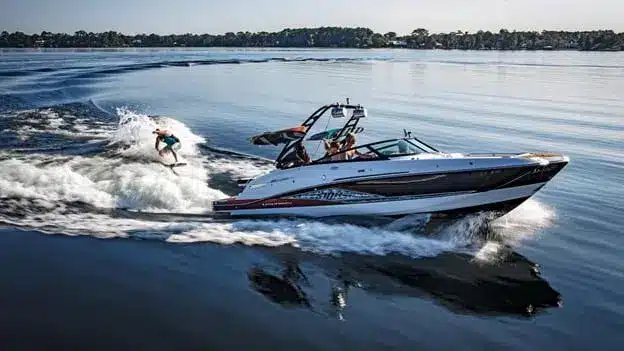
A bowrider can be a practical, social day boat for Sydney Harbour, but the open-bow layout is not automatically the right choice for every family, waterway or weather condition. The best boat is the one that suits where you will use it, how many people you will carry, how it will be stored and the conditions you are prepared to operate in.
This guide explains what a bowrider is, its genuine advantages and limitations, and the questions Australian buyers should answer before choosing one.
What is a bowrider boat?
A bowrider is a recreational powerboat with passenger seating in the open bow area ahead of the windscreen. Most also have a main cockpit behind the helm and seating across or around the stern.
Layouts, hulls and equipment vary widely. Depending on the model, a bowrider may use an outboard or sterndrive, be trailerable or marina-stored, and be intended for sheltered water, general coastal use or particular watersports. Never assume capability from the word “bowrider” alone—check the builder’s specifications and operating guidance for the exact model.
Who does a bowrider suit?
A bowrider may suit buyers who want:
- a sociable day-boat layout with separate seating areas;
- easy movement between the cockpit and bow;
- short family outings on suitable waterways;
- swimming, picnics or approved tow-sport activities;
- a boat that can be stored on a trailer or dry stack, where the model permits; and
- open-air boating rather than overnight accommodation.
It may be less suitable if your priority is overnighting, extensive weather protection, offshore passages, a fully enclosed cabin or carrying passengers who need to remain out of sun, spray or wind.
Advantages of a bowrider
Social seating
The open bow creates an additional passenger area and can prevent everyone being crowded into the aft cockpit. A well-designed walkthrough makes it easier to move between areas while the boat is stationary.
Good visibility and an open feel
Passengers often enjoy the view and airflow from the bow. The open layout can make a modest-length boat feel spacious for day use.
Versatile day-boating use
Depending on the model and equipment, a bowrider may support cruising, swimming, fishing, picnics and tow sports. Confirm that the hull, towing point, engine, propeller protection, seating and local rules suit the intended activity.
Storage options
Some bowriders can be trailered or stored in dry stack, while larger models may be kept in a berth. Storage suitability depends on the boat’s actual length, beam, height, weight and lifting points—not its category name.
Limitations of a bowrider
The bow is exposed
Passengers in the bow have less protection from wind, spray, cold and sun. In short, steep water, an open bow can also take spray or water over the front if the skipper uses an unsuitable speed or angle.
Weather protection varies
A windscreen and bimini can help, but many bowriders provide less shelter than a cabin boat. Covers and clears can also change visibility and windage. Inspect the exact protection available and consider how quickly Sydney conditions can change.
Limited overnight and private facilities
Some larger models have a small toilet compartment, sink or refrigeration, while many do not. These are model-specific options, not standard bowrider features. If a toilet, freshwater system or overnight accommodation matters, inspect it rather than relying on a sales category.
Passenger comfort depends on the sea state
The bow can experience greater vertical movement than the centre of the boat. A seating position that feels pleasant in flat water can become uncomfortable in chop or ferry wash. The skipper must adjust speed and passenger positions to the conditions.
Are bowriders suitable for Sydney Harbour?
Many bowriders are used successfully on Sydney Harbour, but suitability depends on the exact boat, route, forecast and operator.
Sydney boaters should consider:
- frequent ferry and commercial-vessel wash;
- short, steep chop when wind runs along an exposed reach;
- busy traffic and the need for an uninterrupted lookout;
- rapid changes between protected bays and exposed headlands;
- limited weather protection for children or older passengers;
- marina, ramp or dry-stack access; and
- whether the planned route goes outside sheltered waters.
A boat that suits a calm trip from a sheltered marina to a nearby destination is not automatically suitable for an offshore passage. Read the builder’s limitations and check the Sydney Enclosed Waters Forecast before each trip.
Bowrider buying checklist
1. Define your real use
List the trips you expect to make most often, not the trip you might make once. Record the waterways, typical passenger number, children, watersports, fishing, swimming, storage location and whether you intend to travel outside enclosed waters.
2. Check passenger and load capacity
Powered recreational vessels should display an Australian Builders Plate or applicable safety label showing capacity and load information. Capacity includes people and equipment. Confirm the requirements with Transport for NSW and never treat the number of visible seats as the legal or safe passenger limit.
Read the current NSW skipper responsibilities for people on board.
3. Assess the hull and freeboard
Ask the builder or surveyor how the hull is intended to perform in the water you will use. Consider bow height, cockpit drainage, deadrise, stability at rest and how the hull behaves in chop, turns and following seas. No single measurement proves that a boat is right for every condition.
4. Choose the propulsion system carefully
Bowriders may use outboards, sterndrives or other propulsion arrangements. Compare:
- service access and local technician support;
- manufacturer maintenance requirements;
- trim behaviour and low-speed control;
- propeller location around swimmers;
- fuel type, tank size and realistic range;
- corrosion protection and flushing; and
- the effect of engine weight and position on the boat.
5. Inspect the layout with your normal crew
Sit in every position. Check whether passengers have secure handholds, can keep their bodies inside the boat and can move safely when the vessel is stationary. Look for trip hazards, sharp hardware and places where children could reach controls, gates or the swim platform.
Passengers on powered vessels must not extend any part of their body beyond the sides or bow while underway, subject to limited exceptions in the NSW rules. Open-bow passengers need safe seats and handholds, and the skipper must reduce speed for their safety and comfort.
6. Check storage, covers and weather protection
Confirm where lifejackets, lines, fenders, anchor equipment, food and personal gear will be stored without blocking access. Check how the boat is covered, whether water drains correctly and whether a bimini or clears affect the skipper’s view.
7. Confirm towing or marina dimensions
For trailer storage, confirm the complete towing weight, beam, height, tow-vehicle capacity and launch-ramp suitability. The advertised dry hull weight does not include every engine, battery, fuel, water, trailer or item of gear.
For dry stack or marina storage, obtain written confirmation that the operator can accommodate the boat’s actual dimensions, weight and lifting requirements. Ask about access times, launch notice, washdown, shore power and weather procedures.
8. Build the ownership budget
The purchase price is only one part of ownership. Budget for:
- registration and insurance;
- berth, mooring, dry stack or trailer costs;
- scheduled engine and drive servicing;
- antifouling where required by the storage method;
- batteries, covers, upholstery and detailing;
- safety equipment replacement and servicing;
- fuel; and
- practical training.
Avoid relying on a generic “entry price”. Model prices and included equipment change, and two boats with the same advertised length can have very different ownership costs.
9. Arrange independent checks for a used boat
A used-boat purchase may require several different checks:
- an independent marine survey of the hull and systems;
- a mechanical inspection and engine diagnostics;
- a sea trial;
- service-history and hours verification;
- registration, ownership and security-interest checks; and
- confirmation of insurance requirements before settlement.
Use our used-boat pre-purchase inspection guide to prepare.
Essential safety considerations for bowrider owners
- Carry the required approved lifejackets and know when they must be worn.
- Keep passengers inside the boat and seated appropriately while underway.
- Never let a person use the swim platform while an engine is operating.
- Account for every person before starting an engine or engaging gear.
- Keep the skipper’s visibility clear through the windscreen and around passengers.
- Reduce speed for wash, chop, visibility and passenger comfort.
- Secure loose equipment so it cannot move or block a walkway.
- Brief the crew before docking, towing or anchoring.
Check the current NSW essential safety-equipment guidance for the boat and waterway.
Your first outings in a new bowrider
Learn the boat in stages:
- Read the owner’s manuals and identify every control, battery switch, seacock, bilge pump and safety item.
- Practise starting, stopping, steering and selecting neutral in open water.
- Learn the boat’s pivot point, windage and stopping distance.
- Practise slow-speed turns and reversing away from other vessels.
- Set up repeatable departure and return routines at your home berth or ramp.
- Introduce passengers only when the skipper can control the boat without rushing.
The BoatWise new boat owner guide provides a broader roadmap.
Frequently asked questions
Are bowriders safe for children?
They can be used safely when the vessel is suitable, the skipper follows the rules and children have approved, correctly fitted lifejackets, appropriate seating, supervision and clear boundaries. The open bow creates additional exposure to movement, spray and sun, so conditions and speed matter. Read our boating with children safety guide.
Can a bowrider go offshore?
Some individual models may be designed and equipped for particular open-water use; others are not. “Bowrider” alone does not answer the question. Follow the builder’s design and operating guidance, required safety equipment, weather and the skipper’s capabilities.
Is an outboard or sterndrive better?
Neither is universally better. Compare maintenance access, local support, storage, performance, draft, swim-platform arrangement, corrosion protection and how the system suits your use.
How many people can a bowrider carry?
Use the capacity on the Australian Builders Plate or applicable safety label and account for the total load. Do not use the number of seats as the limit.
Do bowriders have toilets?
Some larger models include a small enclosed toilet compartment; many smaller models do not. Check the exact model and whether the system is practical to access, maintain and legally discharge.
Train on your new bowrider
BoatWise Private Boat Tuition is personalised to your boat, your marina and your goals. Training can cover onboard systems, slow-speed handling, docking, wind and current, anchoring, navigation, crew communication and safe family routines in the environment where you will actually use the boat.
About the author
Tristian Mooney is the founder, captain and head trainer of BoatWise. He has spent 12 years in the maritime industry and has worked across thousands of makes and models, from small trailer boats to large luxury cruisers. His approach is calm, practical and tailored to the person, vessel and marina. Learn more about Tristian and BoatWise.
Last reviewed: 11 August 2026. Boat specifications, prices, operating limits and NSW rules can change. Verify the exact model, manufacturer guidance and current official requirements before buying or operating a vessel.