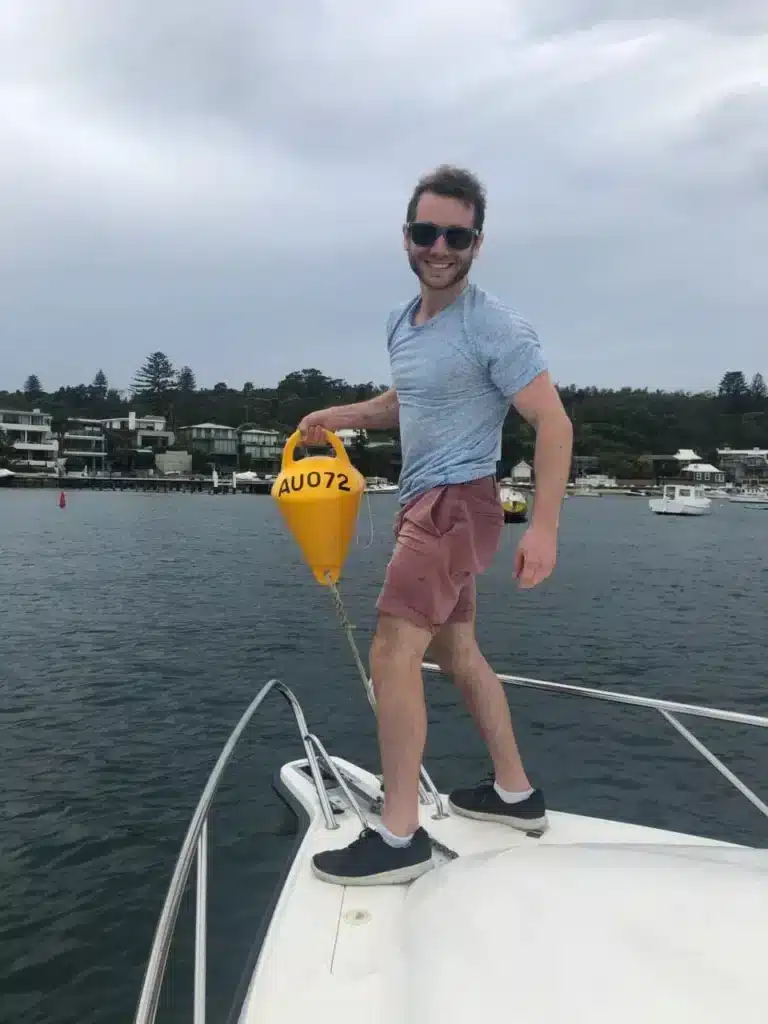
Picking up a mooring buoy looks simple from a distance, but the final few metres combine low-speed boat control, wind and current, limited visibility from the helm, crew communication and a rope close to the water.
This six-step guide explains a safe planning method for recreational powerboats. Mooring systems, pickup lines and attachment points differ, so inspect the arrangement and follow the owner, operator or authority’s instructions. Do not use a private mooring without permission.
How to pick up a mooring buoy in six steps
- Confirm that you are permitted to use the mooring.
- Inspect the area and identify the dominant force.
- Prepare the boat, line and crew before approaching.
- Approach slowly into the dominant force with an escape route.
- Select neutral before the pickup line is close to the propeller.
- Secure the vessel to the correct load-bearing point and check the set.
Before you begin: identify the type of mooring
A buoy does not automatically mean the mooring is available. It may be:
- a private licensed mooring;
- a marina or club mooring allocated to a customer;
- a publicly available or destination mooring with conditions and time limits;
- a courtesy mooring managed by a park or other authority; or
- a navigation, hazard, special or scientific marker that must not be used for mooring.
Check signs, charts, buoy markings and current operator information. The official NSW mooring and anchoring guidance explains mooring responsibilities and restrictions. For planned Sydney Harbour stops, use the BoatWise guide to destination berths and moorings.
Never assume a mooring is suitable for your vessel’s length, displacement or windage. Confirm size limits, availability, time restrictions and booking requirements before relying on it.
Step 1: confirm permission and suitability
Before the approach, confirm:
- the mooring can legally be used;
- it is available and not allocated to another vessel;
- the vessel is within the permitted size or displacement;
- the water depth and swing room are suitable;
- the mooring is not visibly damaged, submerged or fouled;
- the forecast and exposure are appropriate; and
- you understand any time limit, fee, booking or attendance condition.
A mooring buoy indicates the surface position of a system below. It does not guarantee the condition of the chain, block, rope or fittings. If anything appears damaged or unsuitable, do not attach the boat and report it to the operator where appropriate.
Step 2: identify wind, current and your escape route
Circle at a safe distance if necessary and observe how nearby moored vessels are lying. Check flags, ripples, floating debris and the boat’s movement against fixed shore references.
The strongest influence may be:
- wind on the hull and superstructure;
- tidal or river current on the underwater hull;
- waves or wash;
- the boat’s existing momentum; or
- a combination that changes near the buoy.
Plan to approach generally into the dominant force so the engine can control the final movement. However, do not copy the direction of a different vessel without checking: sailing boats, catamarans and powerboats can lie differently to wind and current.
Choose a point at which you will abandon the approach. Make sure moving ahead and away will not place the boat, swimmer, crew or rope near another vessel or obstruction.
Step 3: prepare the crew and equipment
Complete the preparation before entering the final approach:
- choose whether the pickup will be from the bow, side deck or another safe position;
- identify the strong point that will carry the load;
- prepare an appropriate boat line if the system requires one;
- ready a boat hook without letting it obstruct movement;
- remove loose ropes from the deck edge and propeller area;
- brief one crew member on the pickup and one on communication if needed; and
- agree on simple calls such as “in sight”, “two metres”, “neutral”, “secured” and “line clear”.
The crew member should remain inside the rails and use a stable working position. Do not lean beyond a safe reach or wrap a line around a hand. An unsuccessful pickup is a reason to reset, not stretch farther.
Lifejacket requirements depend on the vessel, people, waterway and conditions. Use the current NSW lifejacket and safety-equipment guidance for the trip.
Step 4: make a slow, controlled approach
Line the boat up early and approach at the slowest speed that maintains control. Use short idle-ahead inputs followed by neutral, watching movement over the ground rather than only the water beside the hull.
Aim to stop the chosen pickup position beside or just short of the buoy. Do not drive the bow over the pickup line. From many helms the buoy disappears from view during the final metres, so the crew’s distance calls become important.
The skipper should know the crew’s location but continue maintaining a lookout. If the angle, speed or communication is wrong, move clear and try again. Avoid reversing over an unseen rope.
Step 5: select neutral before the line is close
A rope around a propeller can disable propulsion and create a serious hazard. Before the buoy, pickup line or boat hook reaches the propeller zone:
- select neutral;
- confirm the boat has minimal forward movement;
- tell the crew that the propulsion is neutral;
- keep every loose line on deck or under positive control; and
- do not re-engage gear until the crew confirms all lines are clear.
Neutral does not guarantee a propeller has stopped rotating immediately, and an engine can still be accidentally engaged. Follow the vessel’s safe operating procedures. If the pickup cannot be completed without placing a person or rope at risk, abandon the attempt.
Step 6: secure to the correct part of the mooring
Use the pickup line or boat hook to retrieve the mooring’s pennant or eye as intended. The small pickup rope may only be designed to lift the load-bearing pennant—it may not be the part that should hold the boat.
Attach the load-bearing component to a suitable bow cleat or strong point as instructed. Keep the lead fair and avoid sharp edges. If using your own line through an eye, check whether the setup will saw back and forth and chafe. Do not improvise an attachment to railings, anchor rollers or fittings that are not designed for the load.
After securing:
- allow the boat to fall back gently;
- check that the connection is carrying the load correctly;
- confirm there is adequate distance from nearby boats and hazards;
- look for chafe, twists, damaged rope or abnormal loading;
- monitor the boat through changes in wind, tide and wash; and
- follow the mooring operator’s attendance and time-limit conditions.
Picking up a mooring single-handed
Single-handed pickup should be planned for the actual boat. Visibility, access from helm to deck, freeboard, windage and the ability to leave the helm safely determine the method.
A conservative approach is to:
- prepare the boat hook and all lines within safe reach;
- approach so the pickup point finishes beside the helm or accessible deck position;
- remove almost all movement and select neutral;
- confirm the boat is safe to leave the controls briefly;
- retrieve and secure the correct mooring component; and
- reset immediately if wind or current carries the boat beyond safe reach.
Do not use an autopilot as a substitute for controlling the boat in close quarters. If the helm and pickup position cannot be managed safely by one person, use crew or obtain instruction in a suitable method.
How to leave a mooring safely
Departure deserves the same preparation as arrival:
- Start the engine and confirm normal steering, cooling, gauges and controls before releasing.
- Brief the crew and identify the clear departure direction.
- Check traffic, wind, current, nearby boats and the location of every rope.
- Take the load off the mooring line without motoring over it.
- Release or return the pennant as the operator intends.
- Keep propulsion in neutral until the line and buoy are visibly clear.
- Move away slowly while maintaining a lookout astern as well as ahead.
Do not throw a long loose line into the water and immediately select gear. Confirm it has sunk or drifted clear of all propulsion before moving.
Common mooring-buoy mistakes
- Approaching a private or unsuitable mooring without permission.
- Following another boat’s heading without checking the dominant force.
- Arriving too fast and expecting the crew to stop the boat with a rope.
- Letting the buoy disappear under the bow while still in gear.
- Placing a rope or boat hook near a moving propeller.
- Securing to the lightweight pickup line instead of the load-bearing pennant.
- Using an unsuitable cleat or fitting.
- Failing to check swing room, chafe or changing conditions.
- Releasing the mooring before the engine and steering have been checked.
Frequently asked questions
Should I approach a mooring into the wind or current?
Approach generally into the strongest force so the boat can be controlled against it, but first identify whether wind, current or both dominate your vessel. Nearby boats may not lie the same way as yours.
Do I secure the boat to the pickup rope?
Not unless that is how the particular system is designed. A thin pickup rope often only retrieves the stronger pennant, eye or chain that carries the vessel’s load. Follow the mooring owner or operator’s instructions.
Can I use any empty mooring in NSW?
No. Many moorings are private or allocated. Confirm permission and the conditions of any public, destination or courtesy mooring before using it.
Why should the engine be in neutral near the line?
It reduces the risk of drawing the pickup line or another rope into operating propulsion. The crew should confirm every line is clear before the skipper re-engages gear.
What if I miss the buoy?
Leave the rope, maintain control and move clear using the planned escape route. Reassess wind and current, reset the crew and make another slow approach. Do not reverse blindly over the buoy or ask somebody to overreach.
Practise mooring approaches on your own boat
BoatWise Private Boat Tuition can cover mooring-buoy approaches, crew roles, close-quarters control, wind and current, docking and anchoring on your vessel in Sydney.
For a deeper explanation of the forces affecting the final approach, read How to Dock a Boat in Wind and Current.
About the author
Tristian Mooney is the founder, captain and head trainer of BoatWise. He has spent 12 years working in the maritime industry across practical boat handling, vessel operations, training and luxury-vessel management. He has worked across thousands of makes and models, from trailer boats to large luxury cruisers. Learn more about Tristian and BoatWise.
Last reviewed: 11 August 2026. Mooring availability, limits and conditions can change. Confirm current operator information and NSW rules before use.